When it comes to relieving physical discomfort, phytotherapy offers two major players: Arnica montana and Devil's claw. Both are plants with recognized anti-inflammatory and analgesic properties, but are they really interchangeable? Or are there significant differences in their field of action?
In clinical and sports practice, there is often a tendency to use Arnica or Devil's claw interchangeably to treat musculoskeletal problems. However, our decade of experience – gained also in the world of racehorses – has led us to a clear conclusion: the two plants act differently and should be chosen based on the area involved.
In this article we compare the two plants, explaining why Devil's claw proves superior for joint problems, while Arnica excels in muscle and tendon disorders. A comparison that official literature still does not fully explore, but which for us at Officinalis represents a certainty gained in the field.
Devil's Claw: the most effective plant for joints – an insight born among racehorses
A powerful natural remedy, but little understood in its specificity
In the vast landscape of phytotherapy, Devil's claw (Harpagophytum procumbens) is universally recognized as one of the most effective natural remedies to combat musculoskeletal pain. However, there is a fundamental differentiation that is rarely explored in scientific literature or phytotherapy manuals: Devil's claw is particularly effective in the treatment of joint problems, while Arnica montana, although also endowed with important anti-inflammatory properties, shows a greater effectiveness when massaged over muscles and tendons.
This distinction, which does not yet find wide space in academic texts, is the result of empirical experience and observation by Officinalis; it is precisely from our direct experience, in the world of racehorses, that the awareness of this therapeutic difference arises.
The empirical discovery in the world of horse racing
In the Officinalis laboratory, our history has been intertwined for years with that of equine athletes, where rapid and targeted physical recovery is crucial for the animal's performance and well-being. The occasion for reflection arose from various specific episodes, in which the owners and trainers of racehorses that presented marked stiffness and fatigue affecting the knee joint, repeated in the vast majority of cases that devil's claw was more effective in promoting recovery and soothing the area.
We thus introduced into the treatment routine of the racehorse a product with 90% arpagoside, from Devil's claw, in the form of a topical massage gel, perfecting it according to the feedback of the trainers and the staff who directly followed the racehorse.
In parallel, on horses suffering from muscle discomfort, more or less intense, Arnica montana has proven to be faster and more effective in reducing the localized problem and promoting recovery, especially when applied locally.
If it works on the horse, imagine on the human: zero placebo and joints 5 times bigger
Unlike humans, the horse is not subject to the placebo effect: it does not expect to improve, nor can it be psychologically conditioned by the treatment. For this reason, its clinical response is considered more objective and reliable. Furthermore, the joint of a horse – like that of the knee (femoro-patellar joint) – can be up to 5 times larger and more massive than the human one, subjected to enormous forces during the race. If a high-potency Devil's claw extract is effective on such an imposing joint, imagine the benefit on that of a person.
Joints and muscles: two distinct physiological worlds, two different phytotherapies
Devil's claw, in particular in forms highly rich in arpagoside, performs a systemic and deep soothing action, but with a high tolerability profile.
Arnica montana, on the other hand, acts mainly on the muscle and tendon tissue, thanks to its sesquiterpene lactones such as helenalin and its derivatives (e.g. helenalin acetate).
The Officinalis approach: from practice to formulation
From experience with racehorses, we developed a model of differentiated phytotherapy:
-
For joints (such as knee, shoulder, elbow, wrist and ankle): high-concentration Devil's claw, from 5 extracts in synergy to take the whole phytocomplex, as we did for White Claw 90%.
-
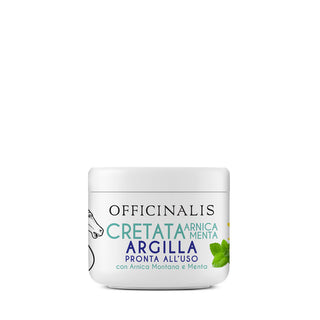
For muscles and tendons: Arnica montana, also in high concentration, and obtained through a variety of extracts, that is, Arnica gel 90% by Officinalis.
This awareness allowed us to achieve targeted results, reducing recovery times and improving the quality of life of the treated animals – and, subsequently, of people, with equivalent formulations.
Conclusions: intuition, experience and advanced phytotherapy
Phytotherapy is a living science, which is continuously enriched by new observations and practical adaptations. We at Officinalis believe that the key to effectiveness lies in the specificity of use of the plants, recognizing that not all act in the same way on every body area.
Devil's claw is the most effective ally for joints. Arnica is undoubtedly valuable, but gives its best in muscles and tendons.
Sometimes, a scientific discovery is not born only from laboratories, but from the race of a horse and the careful eye of who cares for it.